
The information provided in this article is intended solely for general informational and educational purposes related to U.S. laws and legal topics. It does not constitute legal advice, legal opinions, or professional legal services, and should not be considered a substitute for consultation with a qualified attorney or other licensed legal professional.
While efforts have been made to ensure the information is accurate and up to date, no guarantees are given—either express or implied—regarding its accuracy, completeness, timeliness, or suitability for any specific legal situation. Laws, regulations, and legal interpretations may change over time. Use of this information is at your own discretion.
It is strongly recommended to consult official sources such as the U.S. Government (USA.gov), United States Courts, or relevant state government and court websites before acting on any information contained on this website or article. Under no circumstances should professional legal advice be ignored or delayed due to content read here.
This content is of a general and informational nature only. It is not intended to replace individualized legal guidance or to establish an attorney-client relationship. The publication of this information does not imply any legal responsibility, guarantee, or obligation on the part of the author or this site.
You know when you’re watching a courtroom drama, and the judge suddenly starts talking about “evidence”? It can get super confusing, right?
Well, one of the key rules behind all that is Federal Rule of Evidence 104. It’s not just a bunch of legal jargon; it actually has a big impact on how cases are decided.
So, what’s the deal with this rule? Basically, it’s about figuring out what evidence gets to come into play during a trial.
Imagine being in a case where some crucial evidence might miss out because it doesn’t meet this rule’s standards. That could change everything!
Let’s break it down and see why understanding this rule can be pretty important—especially if you’re ever curious about how trials really work or even find yourself in jury duty someday!
Understanding the Difference Between Evidence 104 A and 104 B in Legal Proceedings
Understanding the difference between Evidence 104(a) and 104(b) can feel a bit like wading through a marsh—kind of sticky and confusing. But don’t worry, I’ll break it down for you in a straightforward way.
First off, let’s talk about **Federal Rule of Evidence 104**. This rule outlines how judges determine whether evidence is admissible in court. Think of it as the gatekeeper of what gets to influence the jury’s decision. Now, this rule has two parts: 104(a) and 104(b). They’re like two sides of the same coin, but they handle different situations.
Evidence 104(a) deals with whether evidence is competent or admissible at all. This means that if there’s a dispute about whether something can even be used in trial—like if it’s relevant or not—the judge makes that call under this rule. Say you have a witness whose testimony seems shaky or irrelevant; a judge will look at it under 104(a) to figure out if it should get included in the trial.
On the flip side, there’s Evidence 104(b). This part focuses on conditional relevance. Basically, it’s about showing that certain pieces of evidence are only relevant if other facts are proven first. For instance, let’s pretend there’s a letter that could paint someone as guilty but only if you also prove that person had motive or opportunity beforehand. Here’s where 104(b) kicks in—the judge will decide if those other facts have been established before allowing that letter into play.
- Rule 104(a): Judge decides if evidence is admissible at all.
- Rule 104(b): Judge examines whether conditions must be met for evidence to be relevant.
Now let’s look at an emotional moment to make this clearer. Imagine you’re in court watching a trial unfold—maybe it’s about something serious like an accident where someone got hurt badly. If there’s some disputed footage from security cameras, 104(a), comes into play first; the judge has to decide: does this footage show what it claims? Is it trustworthy? If yes, then onto (b). The lawyers may argue whether this footage is applicable in light of alibis or timelines.
This whole process emphasizes how important judges are when making calls on evidence—they’re shaping what you eventually see as a jury member!
So, when you’re following legal proceedings and hear terms thrown around like “admissibility” or “conditional relevance,” now you have solid ground to understand what folks are talking about behind those closed courtroom doors!
Understanding the Federal Rules of Evidence: A Comprehensive Guide to U.S. Legal Standards
The Federal Rules of Evidence are pretty important in U.S. courts. They help ensure that trials are fair and the evidence presented is reliable. We’re going to break down Rule 104 in a way that makes it easy to understand.
Rule 104 Overview
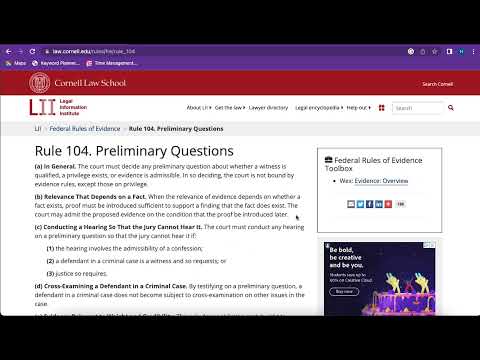
So, Rule 104 is all about the “preliminary questions” that judges have to decide before evidence can be introduced at trial. Basically, it’s like a gatekeeper for what can come into the courtroom. This rule helps keep bad evidence out, you follow me?
Admissibility Hearings
Judges often hold hearings under this rule to figure out if certain evidence is admissible. For instance, let’s say there’s some expert testimony about a scientific method. The judge will need to decide if that expert is qualified and if their method is reliable before letting them speak in front of the jury.
Two Main Types of Questions
There are two big types of questions judges address under Rule 104: whether a witness can testify and whether evidence is admissible.
- Witness Competency: A judge might have to determine if someone can actually be a witness. Like, does this person have firsthand knowledge about the case? If they don’t know anything, they can’t get up on the stand.
- Evidentiary Rules: Sometimes it’s not just about who gets to talk but also what got into the trial in the first place. For example, hearsay—what people say that isn’t based on their direct knowledge—can create problems here.
The Standard of Proof
When judges make these determinations, they don’t need proof beyond a reasonable doubt like juries do for guilty verdicts. Instead, they use a lower standard: “preponderance of the evidence.” So if it seems more likely than not that this evidence or testimony is credible or valid, then it gets through.
Anecdote Time
Imagine you’re sitting in court for your buddy’s trial over something trivial, like who borrowed whose lawnmower last summer—and trust me, there are way bigger fish to fry! But then your buddy’s lawyer says they want to bring in an expert on lawn care equipment. The judge holds an evidentiary hearing first under Rule 104 to see if this expert has any real knowledge or background on lawnmowers! It turns out they used one at summer camp once—definitely not enough experience! So that testimony never makes it into your friend’s trial.
No Jury Interaction
Another thing? During these hearings under Rule 104, juries don’t get involved at all! Judges handle all these preliminary matters without any influence from juries because they’re only meant to weigh the evidence after everything is settled.
In short, understanding Rule 104 helps clarify how courts manage different types of evidence and witnesses before juries even hear them out. It keeps things organized and fair so we’re not just throwing random stuff at juries and hoping something sticks!
Understanding the Best Evidence Rule: A Simple Explanation of Key Legal Concepts
The Best Evidence Rule, you know, is a pretty fundamental principle in U.S. law, specifically within the Federal Rules of Evidence. It basically says that when you’re trying to prove the content of a document or recorded information, you need to use the original material rather than just a copy or verbal testimony about it.
You might be thinking, “Why does it matter?” Well, think of it this way: imagine you’re in court trying to show evidence from a text message. If you have the actual phone with the messages on it—or even an official printout—that’s stronger evidence than just someone saying what was in that text, right? It keeps things clear and reduces confusion.
So, here’s how this works under Federal Rules of Evidence 104. The judge decides whether the best evidence rule applies. It’s not about whether something is true or false; it’s about what can actually be shown as proof in court. Here are some key points:
- The original document matters: When you want to present evidence from a writing, recording, or photo, you gotta show the original version unless an exception applies.
- Copies can sometimes work: If the original is lost or destroyed—and it wasn’t your fault—you might be allowed to use a copy.
- Verbal testimony isn’t enough: Just because someone remembers something doesn’t mean that’s valid proof under this rule. You really need that original document.
- Exceptions exist: There are times when copies can be used as legitimate evidence—like if the original’s authenticity is established by other means.
Let me tell you about a real situation that illustrates why this rule is so crucial. Picture this: A person gets accused of fraud based on some emails they supposedly sent to misrepresent their business dealings. The prosecution brings in copies of those emails but doesn’t have the originals. Now, if those accused can show there’s doubt about whether they sent those emails—maybe they were doctored or not even sent at all—the judge might dismiss that evidence because of the best evidence rule.
The Best Evidence Rule helps make sure everyone has access to reliable information. When originals are available and presented properly in court, it enhances trust in legal proceedings.
Understanding how this rule functions can make all the difference during trials and hearings! Keep these concepts locked away for future reference; they’re super useful to know!
So, let’s chat about Federal Rules of Evidence 104. You know, it might sound a bit dry at first, but trust me, it’s pretty interesting when you dig into it. At its core, Rule 104 is all about how judges figure out what evidence can actually be used in court. It’s like the gatekeeper of the courtroom, making sure that only relevant and reliable stuff makes it through to the jury.
Picture this: you’re sitting in a packed courtroom. People are on edge, waiting to hear what evidence will sway the jury’s decision. The judge is there, listening attentively as lawyers argue over what should be allowed and what shouldn’t. That’s where Rule 104 comes into play. You’ve got scenarios where someone might want to introduce evidence that just isn’t trustworthy or doesn’t connect with the case at hand.
One of the most crucial parts of this rule is that judges can hold hearings outside of the jury’s view to decide whether certain evidence is appropriate. Like, let’s say someone wants to bring up a past conviction of a witness to shake their credibility—well, the judge gets to weigh if that’s really relevant and fair game or just muddying the waters.
It kind of reminds me of when I was in high school drama club. We had auditions for a big play—everyone wanted a role! But our director was strict; he only wanted people who could actually perform well. Those tryouts were intense because everyone was vying for their chance—but only those who fit the vision were chosen! Basically, Rule 104 does that for evidence: only letting in what fits and ensuring it won’t lead juries down crazy rabbit holes.
And then there’s that tension between constitutional rights and justice—like when hearsay pops up. Sometimes you’ve got statements made outside court that could be vital but aren’t always allowed because they might not pass muster on reliability. So there’s this balance judges need to strike all the time.
In short, understanding Federal Rules of Evidence 104 helps you appreciate how vital these decisions are in shaping trial outcomes. Every little detail matters here, folks! It’s like putting together a puzzle where each piece must fit just right for the whole picture to make sense—and believe me, that’s super important when people’s lives are on the line or reputations hang in balance!




